

In the world of tobacco harm reduction, smaller states often follow the examples of bigger countries or institutions. While they have smaller populations, the public health decisions those states make are no less important.
The problem is essentially the same everywhere – what is the best way to reduce smoking rates and how can consumers be assisted on their journey to quit?
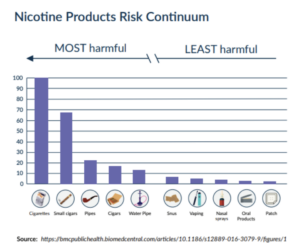
Unfortunately, the debate around nicotine still differs around the world. We witness the tendency to demonise nicotine and attribute the harms related to traditional cigarettes and combustion to nicotine itself. However, one of the most important principles of tobacco harm reduction is that not all nicotine products carry the same level of risk.
A good example of how the policymaking around tobacco can be inconsistent with science in smaller states can be seen in the address of Palau President Surangel Whipps to the UN. In the first part of his speech, he spoke about the importance of scientific evidence in policymaking. However, further on, he failed to acknowledge the scientific evidence around nicotine.
Palau has formally requested the UN Secretary-General to initiate a WHO review of nicotine as a psychotropic substance. Those familiar with the WHO’s approach towards less harmful nicotine alternatives would not expect any positive developments for tobacco harm reduction to come from this.
The WHO has repeatedly dismissed the scientific evidence supporting less harmful nicotine alternatives as tools for smoking cessation and urged countries to adopt prohibitionist policies towards innovative products. Its influence can be particularly significant in smaller countries, such as Palau.
In his speech, the president even stated that “nicotine claims over 7 million lives annually” and called for stronger policies to reduce nicotine dependence, particularly among young people.
This framing is problematic, because the seven million annual deaths commonly cited in this debate are associated with tobacco use, driven by the harms of smoking and exposure to tobacco smoke. Nicotine is addictive, but it is not the main reason people die from smoking.
While it’s a noble goal to reduce youth exposure to nicotine, it’s important to highlight how counterproductive this approach can be for adult consumers.
Why does this difference matter?
Less risky nicotine products can make it easier for adult smokers to quit. We have seen this model succeed in Sweden, which brought its smoking rate below 5% and became the first smoke-free country across the EU, with less harmful products such as pouches, playing an important role.
Importantly, an updated Cochrane Review of 80 randomised trials covering almost 30,000 smokers has found that nicotine vaping helps more smokers quit than nicotine replacement therapy (NRT) such as gums or patches. Cochrane rates the finding “high certainty” (the top grade it issues, and one it awards rarely). Roughly four more people in every hundred quit with nicotine vapes than with patches or gums. It also saw no evidence of increased serious harm, and it found that nicotine vapes work better than nicotine-free ones.
In other words, while governments should work to prevent youth uptake through measures such as strict age limits, they should not ignore the potential of less harmful alternatives for adults who already smoke.
In contrast, another small island state took a different approach at COP11. Saint Kitts and Nevis pushed for a dedicated discussion on tobacco harm reduction within the WHO FCTC, defending their right to adopt policies reflecting their own reality and endorsing science-based policies and harm reduction.
Smaller states should be able to develop tobacco policies that reflect their own public health needs and the full body of available scientific evidence, rather than treating every nicotine product as equal to combustible cigarettes. If Saint Kitts and Nevis could do that, so can other states.
There should not be a choice between protecting young people and helping adult smokers quit.
Science and real-world evidence should lead the way.


 EN
EN  EU
EU  FR_BE
FR_BE  NL_BE
NL_BE  CS
CS  NL_NL
NL_NL  EN_GB
EN_GB  FR
FR  IT
IT  PL
PL  PT
PT  ES
ES  SV
SV  DE_AU
DE_AU  DE_DE
DE_DE  DA
DA  EL
EL  FI
FI  RO
RO