

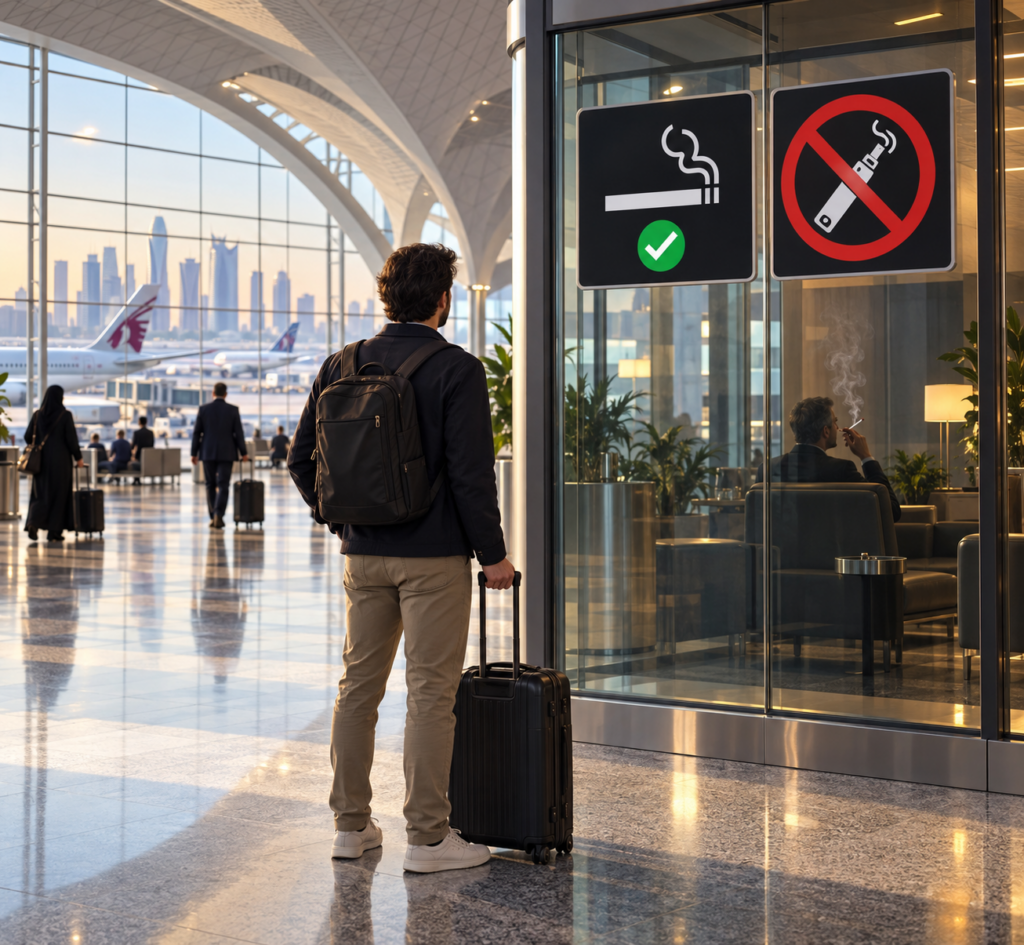
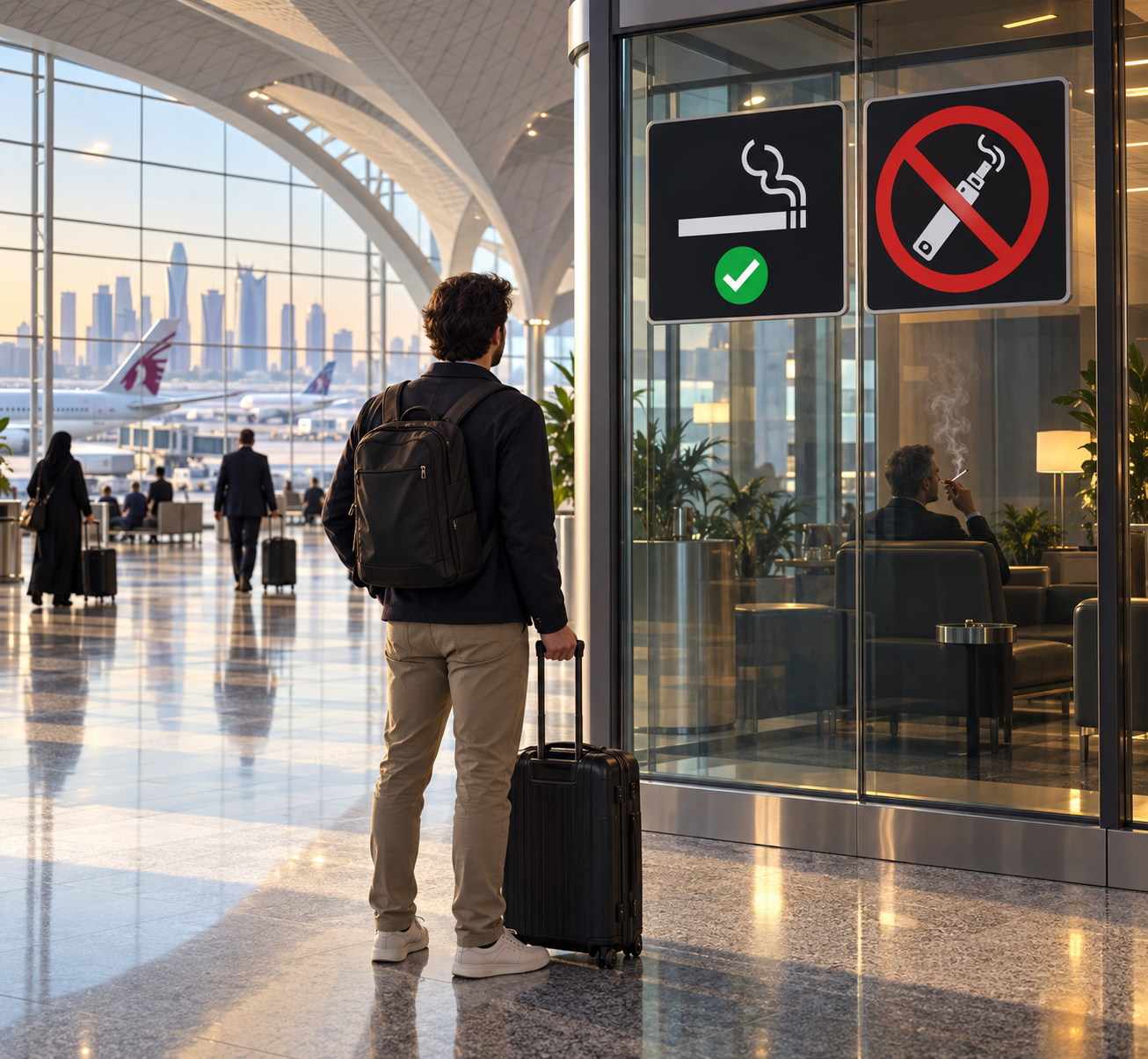
Imagine you land at the Doha airport after a long flight, clearly one of the busiest airports in the world. As a smoker, you won’t experience any problems following the directions to the smoking room. However for vapers – things might get different.
According to Doha airport policies, you are allowed to smoke in the designated areas. However, Hamad International Airport explicitly prohibits the use of e-cigarettes throughout the terminal.
Something does not add up about this policy, does it?
The problem does not start with the airport policy. Let’s take a quick look at Qatar’s tobacco laws to understand the bigger picture.
Since 2016, Qatar has prohibited the import, sale, distribution and manufacture of e-cigarettes. In contrast, combustible tobacco remains legally available. Hence, unlike smokers, vapers can’t legally buy vaping products in Qatar.
Can a tourist bring a vape from their own country to Qatar? Unfortunately, the restrictions do not stop at the sale of vaping products. The law does not provide an exception for tourists bringing vapes for personal use.
Selon le UK government’s travel guideline, Qatar prohibits importation, sale and purchase of vapes regardless of quantity and intended use.
The consequences can be serious. Violating this law can result in a fine of up to QAR 100,000, up to six months imprisonment, or either of these penalties. Vaping products can also be confiscated, regardless of their quantity. For a tourist carrying a vape for personal use, this is certainly something worth knowing before the journey.
So tourists can legally arrive in Qatar carrying traditional cigarettes, but not the vape they have switched to instead.
Now getting back to what happens when a traveller is in a transit area? Interestingly, Qatar Airways allows vapes to be carried in the hand baggage. However, as a consumer, luck is not exactly on your side, as you won’t be allowed to use the vape in the designated smoking rooms.
Generally, the policy guidelines for vapers in transit zones are not clear and can become a matter of frustration for a traveller.
Vapers face unnecessary challenges both when entering Qatar and when simply passing through its main airport. The contradiction is obvious: consumers who have chosen less harmful alternatives face harsher restrictions.
Does this approach really make sense from a harm reduction perspective? The answer should be simple.
In a more reasonable world, risk reduction should be celebrated, rather than punished.



 FR_BE
FR_BE  EU
EU  NL_BE
NL_BE  CS
CS  NL_NL
NL_NL  EN
EN  EN_GB
EN_GB  FR
FR  IT
IT  PL
PL  PT
PT  ES
ES  SV
SV  DE_AU
DE_AU  DE_DE
DE_DE  DA
DA  EL
EL  FI
FI  RO
RO