
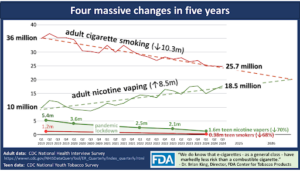
En un hito notable para la salud pública, los Centros para el Control y la Prevención de Enfermedades (CDC) de EE. UU. informaron recientemente que el tabaquismo en adultos ha disminuido a su tasa más baja en 60 años. Según el último informe de los CDC Informe semanal de morbilidad y mortalidad (MMWR), justo 11.2% de los adultos estadounidenses fumaron cigarrillos en 2022, un mínimo histórico que refleja décadas de progreso en la salud pública y actitudes cambiantes sobre el tabaquismo.
Uno pensaría que este sería un momento de celebración. Y lo es, al menos para los defensores del control del tabaco que llevan años luchando por reducir esas cifras.
Pero, como es habitual en los CDC, las buenas noticias llegan con una nube de escepticismo dirigida no a los cigarrillos, sino a las mismas herramientas que muchos adultos están usando para... detener de fumar.
📉 La caída del tabaquismo: una victoria histórica
Los datos de los CDC confirman que el consumo de cigarrillos entre adultos ha mostrado una tendencia descendente constante desde la década de 1960. Las enfermedades relacionadas con el tabaquismo siguen siendo una de las principales causas de muerte evitable, pero este marcado descenso muestra lo que es posible cuando la educación, las políticas y el acceso a alternativas trabajan juntos.
Este es el momento con el que los expertos en salud pública han soñado durante mucho tiempo: menos personas fumando, menor exposición al humo de segunda mano y mejores resultados de salud a largo plazo para millones de personas.
⚠️ Sin embargo, el enfoque de los CDC se centra en los cigarrillos electrónicos
A pesar de esta victoria histórica, los CDC decidieron destacar una estadística diferente en el mismo informe: una Aumento del uso de cigarrillos electrónicos entre adultos, ahora en 6.7%. En lugar de reconocer el papel del vapeo en la reducción del consumo de cigarrillos tradicionales, la agencia lo trató como una nueva amenaza.
Peor aún, la narrativa de los CDC parece hacerse eco de las preocupaciones impulsadas por los grupos anti-vapeo respaldados por Bloomberg que se han opuesto durante mucho tiempo a las alternativas a la nicotina, incluso cuando son utilizadas por adultos que intentan dejar de fumar, un hábito mortal.
Esta falta de alineación de prioridades es decepcionante pero no sorprendente.
🔄 Los adultos están cambiando, y eso es algo bueno
Lo que los CDC no reconocen es que el uso de cigarrillos electrónicos entre adultos ha... aumentó a la par que caían las tasas de tabaquismo por una razón: Vapear está ayudando a la gente a dejar de fumar.
Un creciente cuerpo de investigación, que incluye estudios emblemáticos del Reino Unido, Nueva Zelanda y Revisiones Cochrane—muestra que los cigarrillos electrónicos pueden ser más efectivos que las terapias de reemplazo de nicotina (TRN) tradicionales para muchos fumadores.
Al ignorar esta evidencia, las agencias estadounidenses corren el riesgo de socavar el progreso en la reducción de daños y confundir al público. Fumar es el enemigo.no nicotina, y ciertamente no las herramientas que ayudan a las personas a alejarse del tabaco quemado.
🌍 Perspectiva global: La reducción de daños funciona
Otros países están adoptando el vapeo y las alternativas a la nicotina como estrategia de salud pública. Suecia Está en camino de convertirse en el primer país "libre de humo" de Europa, en gran parte gracias al uso generalizado de snus y bolsitas de nicotina. En el Reino Unido, las campañas de salud pública apoyan abiertamente la transición del tabaco al vapeo.

Mientras tanto, los reguladores estadounidenses siguen priorizando los mensajes prohibicionistas sobre las soluciones pragmáticas.
🧭 ¿Hacia dónde vamos desde aquí?
Si los CDC están verdaderamente comprometidos a reducir los daños relacionados con el tabaquismo, entonces deben comenzar a:
- Reconocer el papel del vapeo en adultos para ayudar a las personas a dejar el tabaco combustible
- Dejemos de confundir la prevención juvenil con las herramientas para dejar de fumar para adultos
- Investigación y mensajes de fondos que respalden estrategias proporcionales al riesgo
La salud pública no se trata de perfección, sino de progreso. Y progreso significa atender a las personas donde están, ofrecer alternativas reales y centrarse en... reducción de daños, no mensajes que sólo promuevan la abstinencia.
✅ Reflexiones finales
La tasa históricamente baja de tabaquismo entre los adultos es motivo de orgullo. Pero en lugar de aprovechar este momento para intensificar los temores infundados sobre el vapeo, los CDC deberían aprovechar la oportunidad para desarrollar un enfoque más realista y basado en la ciencia sobre el consumo de nicotina.
El tabaquismo está muriendo y la reducción de daños está ayudando. Mantengamos nuestro enfoque donde debe estar.
📊 Lea el informe completo de los CDC aquí
Descargo de responsabilidad: Las opiniones expresadas en los artículos de invitados publicados en el sitio web de la World Vapers' Alliance son responsabilidad exclusiva de sus autores y no representan necesariamente las opiniones ni la postura de la World Vapers' Alliance ni de sus afiliados. La publicación de contenido de terceros no implica que la WVA respalde las opiniones allí expresadas.





 ES
ES  EU
EU  FR_BE
FR_BE  CS
CS  NL_NL
NL_NL  EN
EN  EN_GB
EN_GB  FR
FR  IT
IT  PL
PL  PT
PT  SV
SV  DE_AU
DE_AU  DE_DE
DE_DE  DA
DA  EL
EL  FI
FI  HR
HR  GA
GA  MT
MT  RO
RO