
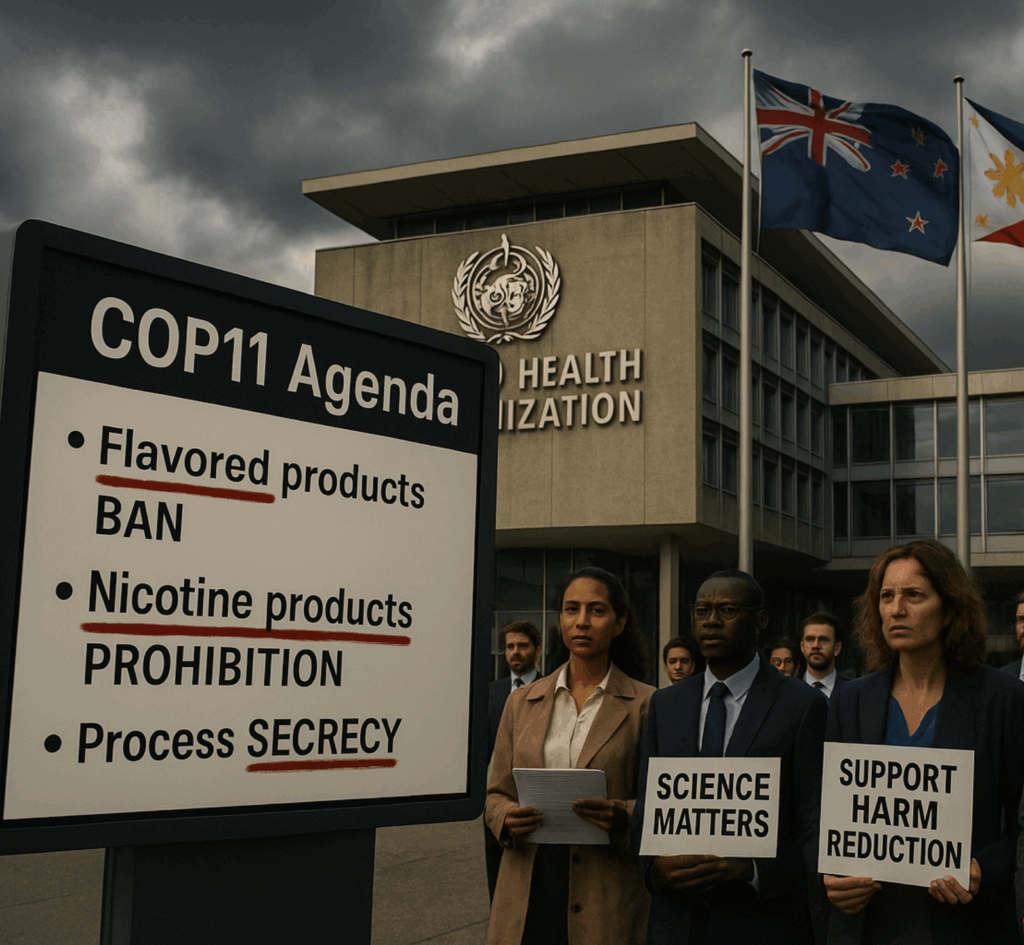
The recently released preliminary agenda for COP11 confirms what many in the tobacco harm reduction (THR) community have long known: the WHO Framework Convention on Tobacco Control (FCTC) is again not preparing for an open, evidence-based conversation on safer nicotine alternatives. Instead, the way the agenda is framed reveals a dangerously biased and ideologically driven direction for the upcoming negotiations.
Item 4.5 reads:
“Implementation of measures to prevent and reduce tobacco consumption, nicotine addiction and exposure to tobacco smoke, and the protection of such measures from commercial and other vested interests of the tobacco industry in light of the tobacco industry’s narrative on ‘harm reduction.’”
This language is not neutral. By referring to harm reduction as part of the “tobacco industry’s narrative”, with quotation marks that cast doubt on its legitimacy, the FCTC Secretariat is pre-framing the entire discussion as defensive and adversarial. It implies that harm reduction itself is a deceptive strategy, rather than a widely recognised and effective public health principle, supported by growing evidence and implemented successfully in countries like Sweden, the UK, New Zealand, and Japan.
Even more concerning is that the agenda point relies on Article 5.2(b) of the FCTC as its legal foundation—an article that does not mention harm reduction at all. By doing so, the Secretariat sidesteps the Convention’s own definition of tobacco control in Article 1(d), which explicitly includes harm reduction. This appears as a deliberate attempt to marginalise both the concept and its global supporters, and potentially opens the door to procedural manoeuvring aimed at silencing or sidelining THR at COP11.
It is also no secret that Article 5.2(b) has previously been misused to bring novel nicotine products—like vaping and pouches—under the same restrictive framework as combustible tobacco. This has repeatedly resulted in prohibitionist policy proposals, despite mounting global evidence that reduced-risk products are successfully helping people quit smoking.
The framing of 4.5 also ignores the apparent diversity of views among Party delegations. At COP10, numerous Parties—including New Zealand, the Philippines, Armenia, Saint Kitts and Nevis, Guyana, and even Australia—made constructive, evidence-based comments supporting or investigating the potential of harm reduction. Several, including Saint Kitts and Nevis, even proposed a Working Group dedicated to THR.
That proposal is conspicuously absent from the agenda. Its absence despite being submitted under Rule 7(g), which allows Parties to propose items, raising serious concerns about transparency. Once again, it appears the Secretariat is actively shaping the scope of the discussion rather than enabling open debate.
By framing the issue narrowly through a defensive lens and anchoring it in an inappropriate article, the Secretariat is discouraging exactly the type of evidence-based engagement the FCTC should promote. Rather than treating harm reduction as a bad-faith industry ploy, the global community should use COP11 to explore how a wide range of solutions—including safer nicotine products—can contribute to reducing smoking-related disease and death.
If the FCTC wants to regain its credibility and be an effective guide in global tobacco control, the discussion at COP11 must be reframed.
Evidence doesn’t come in quotation marks. COP11 must respect the facts and the voices of those who are choosing safer alternatives to quit smoking. Harm reduction is not a narrative. It is a life-saving strategy.

 EN_GB
EN_GB  EU
EU  FR_BE
FR_BE  CS
CS  NL_NL
NL_NL  EN
EN  FR
FR  IT
IT  PL
PL  PT
PT  ES
ES  SV
SV  DE_AU
DE_AU  DE_DE
DE_DE  DA
DA  EL
EL  FI
FI  HR
HR  GA
GA  MT
MT  RO
RO
One Response